




Ever get to the end of the day and wonder where all your time went?
You checked your phone, responded to messages, maybe even crossed off a few tasks… but the important things? Still unfinished. It’s a frustrating cycle, and you’re not alone.
The problem is not that you’re lazy or unmotivated. It’s that most people rely on systems that quietly work against them.
Think about it:
- Too many apps are competing for your attention
- Notifications constantly interrupt your focus
- Tasks buried in digital lists you forget to check
Everything is scattered. And when your attention is scattered, your productivity follows.
That’s where a simple shift can make a surprisingly big difference.
Instead of juggling multiple tools, imagine having a clear, physical view of your entire schedule right in front of you, something you can glance at anytime without unlocking a screen or opening another tab.
This is exactly where an 18-month flat desk calendar comes in.
It may seem old-school at first. But in a world full of digital noise, that’s precisely its advantage. It brings your plans, priorities, and deadlines into one visible, consistent space, helping you stay grounded and focused on what actually matters.
And when you extend that visibility to 18 months, something powerful happens:
You stop reacting to your schedule… and start designing it.
What Is an 18-Month Flat Desk Calendar and Why It Matters
At first glance, a desk calendar might seem like the simplest tool in your workspace. But when it’s designed well, it becomes something much more powerful.
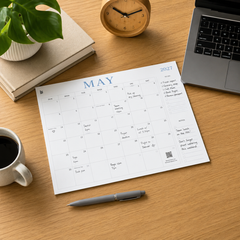
An 18-month flat desk calendar is exactly what it sounds like: a large, easy-to-view calendar that covers a full year plus an additional six months. In this case, that means June 2026 – December 2027 , giving you a longer runway to plan, adjust, and stay ahead.
But the real magic is not just in the timeline. It’s in how the calendar is built and how it fits into your daily workflow.
1. A Bigger View Equals Better Decisions
With a standard planner or digital app, you’re often looking at just a few days or at most, a week at a time. That narrow view makes it harder to connect the dots between what you’re doing today and where you want to be months from now.
A 22x17-inch layout changes that completely.
You can:
- See your entire month at a glance
- Map out deadlines, events, and priorities clearly
- Spot conflicts or gaps before they become problems
Instead of reacting to what’s coming up next, you start planning with intention.
2. The Advantage of a Lay-Flat Design
Not all desk calendars are created equal.
A lay-flat calendar stays open and smooth across your desk or wall without curling, folding, or shifting around. That might sound like a small detail, but in practice, it makes a big difference.
- You can write comfortably across the entire surface
- No fighting with bent pages or awkward angles
- Everything stays clean, readable, and accessible
3. Why 18 Months Beats 12 Months
Most calendars stop at 12 months. That’s fine for short-term planning, but it limits your ability to think ahead.
With an 18-month calendar, you can:
- Plan across school years or fiscal cycles
- Set long-term goals with real visibility
- Prepare for future events without switching tools halfway through
It’s a subtle upgrade that creates a major shift, from short-term thinking to long-term clarity.
4. One Tool. One Place. Total Clarity.
An 18-month flat desk calendar does one thing extremely well:
It puts your life in front of you, clearly, consistently, and without distractions.
No switching between apps.
No forgotten lists.
No hidden tasks.
Just a simple, reliable system that helps you stay focused on what matters most.
7 Ways an 18-Month Desk Calendar Improves Your Productivity
Now that you understand why visual planning works, let’s make it practical.
How does an 18-month flat desk calendar actually improve your day-to-day productivity?
Here are seven ways it quietly transforms how you work and plan.
1. You See Your Priorities Every Single Day
Most productivity systems fail for one simple reason: you forget to check them.
A desk calendar solves that instantly.
Because it’s always visible:
- Your key tasks stay front and center
- Important deadlines don’t sneak up on you
- You’re constantly reminded of what actually matters
2. Long-Term Planning Becomes Effortless
This is where the 18-month format really shines.
Instead of thinking week-to-week, you can:
- Map out major goals months in advance
- Plan projects across seasons or quarters
- Align daily actions with long-term outcomes
You’re no longer reacting, you’re anticipating.
3. You Reduce Digital Distractions
Every time you check your phone, you risk losing focus.
A desk calendar eliminates that cycle:
- No notifications
- No app switching
- No accidental scrolling
You glance down, get the information you need, and stay on track.
4. Time Blocking Becomes Natural
Time blocking sounds great in theory, but many people struggle to stick with it digitally.
On a large 22x17 layout, it becomes simple:
- Write tasks directly into specific days
- Visually balance your workload
- Avoid overbooking yourself
You can see when your schedule is too full and adjust before it becomes overwhelming.
5. Consistency Starts to Build Automatically
Productivity isn’t about big bursts of effort, it’s about small actions repeated daily.
Because your calendar is always visible:
- You’re reminded to follow through
- Habits become easier to maintain
- You stay aligned with your goals
6. You Become More Accountable
There’s something powerful about seeing your plans written out in front of you.
It creates a subtle sense of commitment:
- “I said I would do this”
- “It’s right there, I can’t ignore it”
That visibility increases follow-through in a way digital lists often don’t.
7. Your Mind Feels Less Cluttered
When everything lives in your head, it creates mental noise.
A desk calendar gives your thoughts a place to land:
- Tasks are organized
- Deadlines are clear
- Nothing is floating around unresolved
The result?
More focus. Less stress. Better decisions.
Why the 22×17 Size Is a Game-Changer
If you’ve ever used a small planner or a cramped calendar, you already know the frustration, tiny boxes, messy handwriting, and barely enough room to capture what actually needs to get done.
This is where the 22×17-inch format completely changes the experience.
It’s not just “bigger.” It’s more usable.
1. More Space Means Better Planning
With a larger layout, each day has room to breathe.
You can:
- Write clearly without squeezing everything in
- Add multiple tasks, notes, or reminders per day
- Plan both work and life in the same space
Instead of simplifying your schedule just to fit the page, your calendar adapts to your real life.
2. At-a-Glance Visibility (Even From Across Your Desk)
One of the biggest advantages of a 22×17 desk calendar is how easy it is to see.
You don’t have to lean in or flip pages.
A quick glance gives you:
- Your upcoming deadlines
- Your busiest days
- Your available time
This constant visibility reinforces your priorities without interrupting your flow.
3. Your Desk Becomes a Productivity Hub
Think of this calendar as more than just a planning tool.
It becomes your command center.
Placed at the center of your workspace, it:
- Anchors your daily routine
- Guides your decisions throughout the day
- Keeps your focus aligned with your goals
Everything revolves around it, because everything important is already there.
4. Works for Every Type of Schedule
The beauty of a larger format is its flexibility.
Whether you’re:
- Managing work deadlines
- Coordinating family activities
- Running a business
- Tracking personal goals
5. No More “I’ll Just Remember That”
Smaller planners often force you to prioritize what gets written down and what gets left out.
That’s where things fall through the cracks.
With a 22×17 layout:
- You don’t have to choose what’s “important enough” to write
- You capture everything that matters
- You reduce reliance on memory
And that alone can eliminate a surprising amount of stress.
6. A Small Upgrade That Feels Big
Switching to a larger desk calendar might seem like a minor change, but it has a ripple effect:
- You plan more clearly
- You stay more organized
- You feel more in control
And it all starts with having enough space to think.
How to Use an 18-Month Desk Calendar Effectively
Getting a desk calendar is one thing. Using it well is where the real transformation happens.
The good news? You don’t need a complicated system. In fact, the simpler your approach, the more likely you are to stick with it.
Here’s a practical, no-overwhelm way to turn your 18-month flat desk calendar into a tool you actually rely on every day.
Step 1: Start With What’s Already Fixed
Begin by anchoring your calendar with non-negotiables:
- Deadlines
- Appointments
- Events
- Important dates
These form the structure of your schedule.
Once they’re written down, you’ll immediately see how much space you actually have and where things might get tight.
Step 2: Add Your Priorities (Not Just Tasks)
Instead of filling your calendar with endless to-dos, focus on what truly matters.
Ask yourself:
- What are my top 2–3 priorities this week?
- What moves the needle the most?
Then assign those to specific days.
This keeps your calendar from becoming cluttered, and keeps your focus where it
Step 3: Use Simple Color Coding
You don’t need anything fancy, just a few colors can make a big difference.
For example:
- Blue = Work
- Green = Personal
- Red = Deadlines
- Orange = Goals or priorities
This allows you to scan your calendar instantly and understand your schedule without reading every detail.
Step 4: Leave Space for Flexibility
One common mistake? Overplanning.
Your calendar should guide you, not trap you.
- Avoid filling every single box
- Leave room for unexpected tasks
- Give yourself breathing space
This makes your system sustainable long-term.
Step 5: Build a Quick Daily Check-In Habit
This is where everything comes together.
Take 1–2 minutes each day to:
- Review what’s scheduled
- Adjust if needed
- Stay aligned with your priorities
Because your calendar is already on your desk, this habit happens naturally, no extra effort required.
Step 6: Do a Weekly Reset
Once a week (5–10 minutes is enough):
- Look at the upcoming days
- Shift anything that didn’t get done
- Reconfirm your priorities
This keeps your calendar accurate, and your momentum steady.
Make It Visible, Make It Work
One final tip that’s easy to overlook:
Placement matters.
Keep your calendar:
- Centered on your desk
- Fully visible
- Easy to write on at any moment
If it’s tucked away or covered up, you won’t use it. If it’s visible, it becomes part of your workflow.
Conclusion: Productivity Doesn’t Need to Be Complicated
If there’s one takeaway from everything we’ve covered, it’s this:
You don’t need a more complex system to be productive, you need a clearer one.
Most people struggle not because they lack discipline, but because their tools are scattered, hidden, or overloaded with friction. And over time, that makes it harder to stay consistent.
An 18-month flat desk calendar solves that in the simplest way possible:
- It keeps your priorities visible
- It gives you space to think and plan clearly
- It helps you stay consistent without relying on willpower
No switching between apps.
No digging through lists.
No starting over every few months.
Just one reliable place where your schedule lives, and where your focus naturally follows.
Your Next Step (If You’re Ready for It)
If you’ve been looking for a simpler, more effective way to organize your days and stay ahead of your schedule, this is a great place to start.
Take a closer look at the 2026–2027 18-Month Flat Desk Calendar (22×17) here.

