

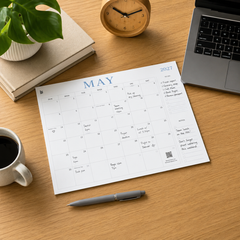



Have you ever bought a brand-new academic planner with the best intentions, only to stop using it after a few busy weeks? You're not alone. Between changing class schedules, unexpected events, vacations, and missed deadlines, it's surprisingly easy for a traditional planner to end up tucked away in a backpack or desk drawer.
The problem is not a lack of motivation, it's that life rarely follows a perfectly dated schedule. When you miss a few pages in a traditional planner, it can feel like you've fallen behind, making it harder to pick it up again. Add in the fact that most planners expire after one school year, and you're left buying a new one year after year.
An undated academic calendar offers a more flexible approach. Instead of locking you into pre-printed dates, it lets you start whenever you need, customize your schedule, and see your academic commitments at a glance. Whether you're a college student balancing classes and work, a teacher planning lessons, a homeschool parent organizing coursework, or a family managing multiple schedules, an undated calendar adapts to your routine, not the other way around.
In this blog, we'll compare traditional planners with undated academic calendars, explore the benefits of each, and help you decide which planning method fits your lifestyle best. If you're looking for a simpler, more adaptable way to stay organized throughout the school year, you may discover that an undated academic calendar is exactly what you've been missing.
The Biggest Problems with Traditional Academic Planners
Traditional academic planners have helped millions of students and educators stay organized over the years, and for many people, they still work well. But they also have limitations that become more noticeable as schedules grow busier and more unpredictable. If you've ever abandoned a planner halfway through the semester, chances are you've experienced one or more of these common frustrations.
Understanding these challenges can help you choose a planning system that better fits the way you actually live, learn, and work.
1. Missing a Week Can Make You Want to Quit
Life gets busy. You might have a week packed with exams, travel, illness, or unexpected family commitments. Before you know it, several pages in your planner are blank.
For many people, those empty pages create a sense of guilt. Instead of simply turning to today's date and moving on, it's easy to feel like you've failed at keeping up with your planner. This "all-or-nothing" mindset often leads people to stop using it altogether.
An undated academic calendar removes that pressure. If you miss a few days, or even a few weeks, you can simply pick up where you left off. There are no wasted pages or pre-printed dates reminding you that you fell behind. Your planning system stays flexible, allowing you to focus on what's ahead rather than what's already passed.
2. Limited Space Makes Long-Term Planning Difficult
Traditional planners are designed around daily or weekly entries, making them great for jotting down assignments or appointments. However, they often make it difficult to see the bigger picture.
Think about everything you may need to plan during an academic year:
- Midterm and final exams
- Research paper deadlines
- Group projects
- School holidays and breaks
- Club meetings
- Sports practices and competitions
- Parent-teacher conferences
- Family vacations
- Work shifts
- Volunteer activities
When these events are spread across dozens of planner pages, it's easy to overlook scheduling conflicts or miss important milestones.
3. Every New School Year Requires Buying Another Planner
Most traditional planners are dated for a specific academic year. Once that year ends, the planner has served its purpose, even if many pages were never used.
This creates a few common frustrations:
- You may start school after the planner's printed dates begin.
- If you take a semester off, parts of the planner become unusable.
- Schedule changes can leave entire sections blank.
- You need to purchase a new planner every academic year.
An undated academic calendar solves these problems by letting you fill in the dates yourself. Whether your school year begins in August, January, or somewhere in between, you can start planning immediately without worrying about outdated pages. Better yet, a reusable dry-erase calendar can be wiped clean and used again for future semesters, making it a practical long-term planning solution.
4. Traditional Planners Are Personal, Not Collaborative
A planner usually stays in your backpack, desk, or laptop bag. That's convenient for personal note-taking, but it also means no one else can easily see your schedule.
For families, roommates, teachers, or homeschool households, this can create communication gaps. Parents may not know when exams are coming up, teachers may want a visible classroom planning tool, and family members might accidentally schedule activities that conflict with important school events.
A large academic wall calendar creates a shared planning space where everyone can see upcoming deadlines, activities, and important dates at a glance. This simple visibility can reduce scheduling conflicts and help everyone stay on the same page.
5. Planning Should Fit Your Life, Not the Other Way Around
The best planning system is the one you'll actually use consistently. While traditional planners remain a good option for detailed daily notes, they aren't always the most flexible choice for today's busy academic lifestyles.
If your schedule changes frequently, you prefer seeing your month at a glance, or you want a planning tool that doesn't become obsolete after one school year, it may be time to consider a different approach.
What Makes an Undated Academic Calendar Different?
At first glance, an undated academic calendar may look similar to a traditional planner or wall calendar. The difference lies in one simple but powerful feature: you decide when it begins.
Instead of following pre-printed dates, an undated calendar gives you a blank framework that you personalize by adding the months, dates, and important milestones yourself. This flexibility means the calendar works around your schedule rather than expecting your schedule to fit a predetermined timeline.
Whether your academic year starts in August, January, or any other month, you can begin planning immediately without worrying about skipped pages or outdated dates.
1. You Start on Your Schedule
One of the biggest advantages of an undated academic calendar is that there is no "right" time to begin using it.
It's ideal for people whose schedules don't follow a traditional school calendar, including:
- College students beginning a new semester
- Teachers hired during the school year
- Homeschool families creating custom learning schedules
- Graduate students starting new programs
- Students returning after a gap semester
- Anyone who simply wants a fresh start
Instead of waiting until the next planner is released, you can start organizing your goals today.
2. You Control How It's Used
An undated calendar is more than a place to write down assignments. Because it's customizable, it can become the central planning hub for nearly every aspect of your academic life.
You might use it to track:
- Assignment due dates
- Midterm and final exams
- Reading schedules
- Study sessions
- Group project deadlines
- School holidays
- Club meetings
- Sports practices
- Volunteer commitments
- Personal goals and milestones
Unlike many planners with fixed layouts, an undated calendar lets you decide what deserves space and attention each month.
3. You Get a Big-Picture View
Traditional planners excel at recording daily tasks, but they often make it difficult to understand how everything fits together over the coming weeks.
An academic wall calendar provides a broader perspective.
Seeing an entire month in one place allows you to:
- Identify busy weeks before they become overwhelming.
- Spread out study sessions instead of cramming.
- Avoid scheduling conflicts.
- Balance academics with work, sports, and family life.
- Prepare for major projects well in advance.
This bird's-eye view encourages proactive planning rather than last-minute scrambling.
4. It's Designed to Be Reused
Another feature that sets many undated academic calendars apart is their reusable design.
For example, a dry-erase wall calendar allows you to:
- Write directly on the calendar with dry-erase markers.
- Update plans as schedules change.
- Erase completed months.
- Reuse the same calendar for future semesters and school years.
This flexibility is especially valuable in education, where schedules often shift due to weather closures, assignment changes, extracurricular activities, or evolving lesson plans.
Rather than crossing out dates or buying a new planner every year, you simply make updates as needed.
5. It Works for More Than Just Students
Although the name suggests it's only for school, an undated academic calendar is useful for anyone involved in the educational journey.
It can help:
- Students stay ahead of assignments and exams.
- Teachers map out lessons, grading periods, and classroom events.
- Parents keep track of multiple children's activities and school commitments.
- Homeschool families organize lessons, field trips, and learning goals.
- Tutors and coaches coordinate sessions and academic milestones.
Its flexibility makes it a planning tool that grows with changing needs instead of becoming obsolete after a single school year.
Five Reasons an Undated Academic Calendar Works Better
Here are five reasons why so many students, teachers, parents, and homeschool families find that an undated academic calendar works better for their needs.
1. You Can Start Whenever You Want
One of the biggest frustrations with dated planners is that they assume everyone follows the same timeline. In reality, academic schedules vary widely.
You might:
- Begin college in January.
- Transfer schools mid-year.
- Start homeschooling at any time.
- Return to school after taking a break.
- Begin tutoring or certification courses outside a traditional semester.
With an undated academic calendar, there's no need to wait for the "right" month or buy a planner that matches your schedule. Simply fill in the dates and begin planning immediately.
This flexibility also means that if you stop using your calendar for a few weeks, you can pick up right where you left off without wasting pages or feeling like you've fallen behind.
2. You Can See Your Entire Month at a Glance
One of the greatest strengths of a wall calendar is visibility.
Instead of flipping through weekly pages to find upcoming deadlines, you can see your entire month in one place. This big-picture view makes it easier to recognize patterns, avoid scheduling conflicts, and prepare for busy periods before they arrive.
For example, you can quickly spot:
- Exam weeks
- Major assignment deadlines
- School holidays
- Club meetings
- Sports tournaments
- Parent conferences
- Family vacations
- Doctor appointments
Seeing everything together helps you make smarter decisions about your time. You may notice that three major projects fall during the same week, giving you the opportunity to begin one earlier rather than rushing at the last minute.
For visual learners, this overview can make planning feel simpler and less overwhelming.
3. It Helps You Balance School and Personal Life
Academic success isn't just about keeping track of homework. Most students and educators juggle multiple responsibilities every week.
An undated academic calendar allows you to organize both academic and personal commitments in one central location.
You might include:
- Classes and lectures
- Homework assignments
- Study sessions
- Part-time work shifts
- Sports practices
- Volunteer activities
- Family events
- Medical appointments
- Personal goals
When everything is visible together, it's easier to avoid overcommitting yourself and to protect time for studying, rest, and recreation.
Instead of maintaining separate calendars for different parts of your life, you can create one organized schedule that reflects your whole routine.
4. It's Reusable Year After Year
Traditional planners have an expiration date. Once the academic year ends, they're usually replaced with a new one.
A reusable dry-erase academic calendar offers a more practical long-term solution.
After each month or school year, you simply erase your notes and prepare for the next planning cycle.
This approach offers several benefits:
- No unused pages going to waste
- No need to purchase a new planner every school year
- Easy updates when schedules change
- A more sustainable alternative to disposable planners
Because academic schedules often evolve throughout the semester, being able to erase and rewrite plans is especially valuable. Whether a test date changes or a school event is rescheduled, updating your calendar only takes a few moments.
5. Everyone Can Stay on the Same Page
Unlike a personal planner that stays tucked away in a backpack or desk drawer, a large academic wall calendar becomes a shared planning center.
This is especially helpful for:
- Families with multiple students
- Homeschool households
- Teachers planning classroom activities
- Study groups
- Roommates coordinating schedules
Because everyone can see important dates at a glance, communication becomes easier.
Parents know when exams are approaching. Students remember project deadlines. Teachers can visualize upcoming lessons and school events. Families can avoid scheduling conflicts because everyone has access to the same information.
A shared calendar also encourages accountability. When goals, deadlines, and commitments are visible, it's easier to stay focused and support one another throughout the academic year.
Who Benefits Most from an Undated Academic Calendar?
One of the greatest strengths of an undated academic calendar is its versatility. While it was designed with education in mind, its flexible format makes it useful for anyone who needs to organize schedules, deadlines, and long-term goals.
Whether you're managing your own coursework, coordinating a classroom, or keeping an entire family on track, an undated academic calendar provides a clear overview of what's ahead. Here are some of the people who can benefit the most.
1. College Students
College life often involves much more than attending classes. Students may be balancing lectures, labs, part-time jobs, internships, study groups, and extracurricular activities, all while preparing for exams and completing assignments.
An undated academic calendar helps college students:
- Track assignment due dates and exam schedules
- Plan study sessions well before finals week
- Balance work shifts with class commitments
- Visualize busy weeks to avoid last-minute stress
- Stay focused on semester goals
Having an entire month visible at once makes it easier to spread out responsibilities instead of cramming everything into a few hectic days.
2. High School Students
As students move through high school, their schedules become increasingly demanding. Between advanced coursework, sports, clubs, volunteer hours, and college preparation, staying organized is more important than ever.
An academic wall calendar can help high school students keep track of:
- Homework and projects
- Test and quiz dates
- SAT or ACT preparation
- College application deadlines
- Athletic practices and competitions
- School events and performances
Learning effective planning habits during high school also builds valuable time-management skills that carry into college and future careers.
3. Teachers
Teachers manage dozens of deadlines beyond daily lesson plans. They often need to coordinate grading periods, parent conferences, school events, professional development days, and classroom activities.
An undated academic calendar gives teachers a visual planning tool for:
- Mapping out lesson pacing
- Scheduling quizzes and exams
- Planning classroom projects
- Tracking grading deadlines
- Organizing school events and meetings
Because plans often change during the school year, a reusable dry-erase calendar makes updating schedules quick and easy.
4. Homeschool Families
Homeschooling offers flexibility, but it also requires thoughtful planning. Parents often coordinate multiple grade levels, learning goals, field trips, extracurricular activities, and family commitments.
An undated academic calendar can serve as a central planning hub for the entire homeschool routine by helping families organize:
- Weekly learning objectives
- Reading assignments
- Science experiments
- Educational field trips
- Testing schedules
- Vacation days
- Family activities
With everything displayed in one place, it's easier to maintain a balanced learning schedule while adapting to changing needs.
5. Parents Managing Multiple Children's Schedules
Even if parents aren't teaching their children at home, keeping up with several school calendars can be challenging.
One child may have soccer practice while another has a band concert, and both may have tests during the same week. Add work schedules, doctor's appointments, and family commitments, and the calendar quickly fills up.
A large academic wall calendar allows parents to see:
- School holidays
- Parent-teacher conferences
- Extracurricular activities
- Exam weeks
- Family appointments
- Birthday celebrations
- Vacation plans
Having a shared calendar in a central location helps everyone stay informed and reduces scheduling conflicts.
6. Graduate Students and Adult Learners
Learning doesn't stop after college. Graduate students, professionals earning certifications, and adults returning to school often juggle coursework alongside careers and family responsibilities.
An undated academic calendar can help organize:
- Assignment deadlines
- Research milestones
- Class schedules
- Certification exams
- Work commitments
-
Personal goals
Because many continuing education programs don't follow traditional academic calendars, the flexibility to start planning at any time is especially valuable.
7. Tutors, Academic Coaches, and Learning Centers
Education professionals outside traditional classrooms can also benefit from a reusable academic calendar.
Tutors and learning centers can use it to:
- Schedule recurring sessions
- Track student milestones
- Plan enrichment activities
- Coordinate testing dates
- Display upcoming events for students and parents
Its large, easy-to-read format makes it an effective planning tool for both staff and learners.
8. Anyone Who Wants a Better Overview of Their Time
You don't have to be a student or teacher to appreciate the benefits of an undated academic calendar.
Many people simply prefer having a large, visual planning system that helps them organize projects, appointments, personal goals, and important dates in one convenient place. If you're someone who likes seeing the "big picture" rather than flipping through pages of a planner, a wall calendar may be a better fit for your planning style.
Â
Â
Tips for Getting the Most Out of Your Academic Calendar
Whether you're using an undated academic wall calendar for the first time or looking to improve your planning routine, these practical tips can help you get the greatest value from it.
1. Color-Code Different Types of Activities
Using different colors is one of the easiest ways to make your calendar more organized and easier to read.
For example, you could assign colors like:
- Blue for classes and lectures
- Red for exams and quizzes
- Green for assignments and projects
- Purple for extracurricular activities
- Orange for work shifts
- Black for personal appointments
With a quick glance, you'll immediately understand what your month looks like without reading every entry.
2. Write Down Important Dates First
Instead of filling your calendar one day at a time, start by adding the biggest events of the semester.
These might include:
- First and last day of classes
- Midterm exams
- Final exams
- Project due dates
- School holidays
- Parent-teacher conferences
- Registration deadlines
- Graduation ceremonies
Once these anchor dates are in place, it's much easier to schedule study sessions, family activities, and free time around them.
3. Break Large Projects Into Smaller Milestones
One of the biggest causes of academic stress is waiting until the last minute to complete a major assignment.
Instead of writing only the final due date, create smaller milestones throughout the month.
For example:
- Research topic selected
- Sources gathered
- First draft completed
- Peer review
- Final edits
- Submission date
Breaking projects into manageable steps makes them feel less overwhelming and helps prevent procrastination.
4. Schedule Study Time Before You Need It
Many students only think about studying when an exam is a few days away.
A better approach is to schedule study sessions as soon as you know the exam date.
Try blocking out:
- Weekly review sessions
- Practice quizzes
- Reading assignments
- Group study meetings
- Revision days before exams
Seeing these sessions on your calendar makes it more likely that you'll stick to your study plan.
5. Include Personal Commitments Too
Your academic calendar shouldn't only focus on school.
Adding personal activities helps create a more realistic schedule and prevents overbooking.
Don't forget to include:
- Family gatherings
- Birthdays
- Medical appointments
- Sports practices
- Volunteer work
- Vacations
- Self-care days
- Fitness activities
When your entire life is visible in one place, it's easier to maintain a healthy balance between school and personal responsibilities.
6. Review Your Calendar Every Week
One of the most effective habits is setting aside a few minutes each week to review your calendar.
A weekly planning session allows you to:
- Prepare for upcoming deadlines
- Move unfinished tasks if priorities change
- Add new assignments
- Update meeting times
- Check for scheduling conflicts
Many people find that reviewing their calendar every Sunday evening or Monday morning helps them start the week feeling prepared and focused.
7. Keep Your Calendar Somewhere You'll See It Every Day
A planning system only works if you actually use it.
Choose a location where your academic calendar naturally becomes part of your daily routine, such as:
- A home office
- A study area
- A bedroom wall
- A family command center
- A classroom
- A homeschool workspace
The more often you see your calendar, the more likely you'll remember important dates and stay on top of your schedule.
8. Don't Be Afraid to Make Changes
One of the biggest advantages of a reusable dry-erase academic calendar is its flexibility.
Schedules change. Assignments get postponed. Meetings are rescheduled. New opportunities arise.
Instead of squeezing notes into tiny spaces or crossing out entire sections, simply erase outdated information and update your plans.
This flexibility encourages you to keep using your calendar throughout the year instead of abandoning it when life doesn't go exactly as planned.
9. Make Planning Part of Your Routine
The most organized people aren't necessarily the busiest, they're often the most consistent.
Even spending just five to ten minutes each week updating your academic calendar can help you:
- Stay ahead of deadlines
- Reduce last-minute stress
- Manage your workload more effectively
- Make time for both academics and personal life
Over time, these small planning habits can make a significant difference in how confidently you navigate the school year.
Frequently Asked Questions
1. What is an undated academic calendar?
An undated academic calendar is a planning tool that doesn't come with pre-printed months or dates. Instead, you fill in the dates yourself, allowing you to start using it at any time during the year. This flexibility makes it ideal for students, teachers, homeschool families, and anyone whose schedule doesn't follow a traditional academic calendar.
2. Is an undated academic calendar better than a traditional planner?
It depends on your planning style. Traditional planners are great for detailed daily notes and to-do lists, while an undated academic calendar provides a larger, month-at-a-glance view that makes it easier to track deadlines, exams, assignments, and activities. Many people find that using a wall calendar alongside a planner gives them the best of both worlds.
3. Can I start using an undated academic calendar in the middle of the school year?
Yes. That's one of its biggest advantages. Since there are no pre-printed dates, you can begin using it whenever you need—whether it's the start of a semester, a new quarter, or halfway through the school year.
4. Who should use an undated academic calendar?
An undated academic calendar is useful for many people, including:
- College students
- High school students
- Teachers
- Homeschool families
- Parents managing multiple school schedules
- Tutors and academic coaches
- Graduate students
- Adult learners
Anyone who wants a clear overview of their monthly schedule can benefit from using one.
5. How does a dry-erase academic calendar work?
A dry-erase academic calendar is designed with a reusable writing surface. Simply write on it using dry-erase markers, update your plans as needed, and erase them when the month or semester is over. This makes it easy to adapt to schedule changes without replacing the calendar.
6. Can an academic wall calendar replace a planner?
For some people, yes. Others prefer using both. A wall calendar is excellent for seeing your entire month at a glance and tracking major deadlines, while a planner is useful for detailed daily notes, checklists, and meeting notes. Many students and teachers use a wall calendar for long-term planning and a planner for day-to-day tasks.
7. How large should an academic wall calendar be?
Choose a size that gives you enough room to write comfortably while remaining easy to read from a distance. Larger calendars are especially helpful for busy schedules or shared spaces. For example, the Undated Academic Own the Year Calendar features a spacious 4-foot by 3-foot layout, providing plenty of room to track assignments, exams, activities, and important events.
8. Where is the best place to hang an academic calendar?
Place your calendar somewhere you'll see every day. Popular locations include:
- Home office
- Study area
- Bedroom wall
- Family command center
- Classroom
- Homeschool workspace
- Dorm room
Frequent visibility helps you stay aware of upcoming deadlines and build a consistent planning habit.
9. What markers should I use on a reusable academic calendar?
Most reusable academic calendars are designed for standard dry-erase markers. Using high-quality dry-erase markers and a soft microfiber cloth for cleaning will help keep the writing surface looking its best. Always check the manufacturer's recommendations before using specialty markers or cleaners.
10. How long can I use an undated academic calendar?
A quality reusable academic calendar can last for many school years with proper care. Because it's undated, you don't have to replace it when a new academic year begins. Simply erase the previous schedule, add the new dates, and start planning again.
Conclusion
Staying organized throughout the academic year doesn't have to mean filling out page after page of a traditional planner. While planners can be useful for daily notes and task lists, they often fall short when it comes to flexibility, long-term planning, and seeing your schedule as a whole.
The most important thing isn't finding the "perfect" planning system, it's finding one you'll actually use consistently. A calendar that's easy to update, simple to read, and always visible can help you stay focused on your priorities and make better use of your time.
Ready to Take Control of Your Academic Year?
If you're looking for a flexible planning tool that works around your schedule instead of the other way around, the Undated Academic Own the Year Calendar is a practical place to start. Its spacious layout gives you plenty of room to track classes, assignments, exams, activities, and personal goals, while the reusable dry-erase surface lets you update your plans as life changes.
Whether you're planning one semester or several years ahead, this calendar is designed to help you stay organized with confidence.
Â

